Undo Citizens United
Elections should be decided by citizens, not corporations, billionaires and dark money. Here is what the ruling did, and the realistic paths to undo it.
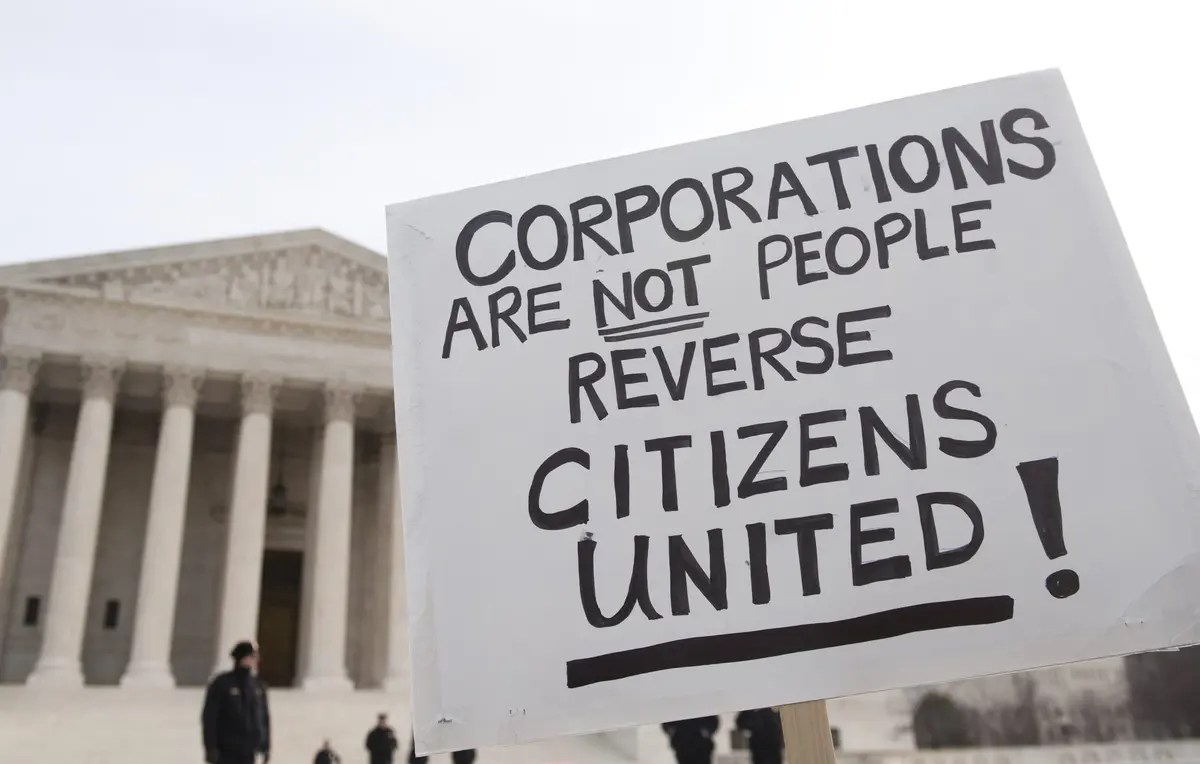
What Was Citizens United?
Citizens United v. Federal Election Commission is a Supreme Court decision handed down on January 21, 2010. By a 5–4 vote, the Court ruled that the First Amendment bars the government from limiting independent political spending by corporations, unions and other associations.
The case began when Citizens United, a conservative nonprofit, wanted to air and advertise "Hillary: The Movie," a film attacking Hillary Clinton, during the 2008 primaries. The Bipartisan Campaign Reform Act (McCain-Feingold) barred corporate-funded "electioneering communications" close to an election. The Court struck that ban down.
January 21, 2010
5–4
Justice Anthony Kennedy, joined by Roberts, Scalia, Alito and Thomas
Justice John Paul Stevens, joined by Ginsburg, Breyer and Sotomayor
The ruling overturned Austin v. Michigan Chamber of Commerce (1990) and part of McConnell v. FEC (2003). It left disclosure requirements in place. Two months later, a federal appeals court relied on it in SpeechNow.org v. FEC to allow unlimited contributions to groups that only make independent expenditures, giving birth to the super PAC.
By the Numbers
Outside spending in federal elections, 2008 vs. 2024
Spent by groups that hide their donors in the decade after the ruling, up from $129M the decade before
Share of federal election spending from the top 100 individual donors, 2008 vs. 2020
Americans who opposed the ruling in a February 2010 ABC News–Washington Post poll
Outside spending in federal elections
Strategies to Undo It: The Center for American Progress Plan
Most people assume only a constitutional amendment or a new Supreme Court majority can undo Citizens United. The Center for American Progress (CAP) argues we do not have to wait. Its plan, written by senior fellow Tom Moore in September 2025, pairs a state strategy with a federal one.
The Corporate Power Reset
"Citizens United was about rights, not powers." Corporations are created by state law and have only the powers states give them. States can amend their corporate codes so corporations and dark money nonprofits are no longer granted the power to spend in elections. No power means nothing for the First Amendment to protect, and it would reach local, state and federal races. Delaware already denies private foundations political spending powers.
Montana Goes First
"The Montana Plan," Initiative 194, was certified in August 2026 for Montana's November 2026 ballot. Entities created under Montana law that spend on campaigns or ballot measures would lose charter privileges such as limited liability. Any state can follow.
Rein In Super PACs
CAP backs the Abolish Super PACs Act (H.R. 2352), introduced in March 2025, which would restore limits on contributions to super PACs and declares SpeechNow was wrongly decided.
Litigate to Build the Record
"Litigate to lose on law but win on facts." Build a detailed court record showing that super PAC "independence" is a sham: single-candidate super PACs acting as shadow campaigns, "redboxing" and shared vendors, and mega-donor checks that function like bribes. That record sets up a future Supreme Court reversal.
Federal Congressional Action
Congress has several tools. None is easy, and most bills need 60 Senate votes under the filibuster, which is why who we elect matters.
A Constitutional Amendment
The Democracy for All Amendment would let Congress and the states set reasonable limits on raising and spending money in elections. It has been reintroduced in nearly every Congress, with 32 Senate sponsors in 2023, and won 54 votes in the Senate in 2014, short of the 60 needed. Ratification requires two-thirds of both houses and 38 states.
The DISCLOSE Act
Reintroduced in March 2026 with 185 House sponsors and all 47 senators in the Democratic caucus. Groups spending over $10,000 on elections would have to disclose donors giving over $10,000, end shell-transfer tricks that hide donors, tighten the ban on foreign money, and disclose paid influencers and the top funders behind political ads. A version passed the House 219–206 in 2010 but died in the Senate.
The Abolish Super PACs Act
Would restore contribution limits to super PACs, attacking the problem created by SpeechNow.
Pressure From the States
Members of 16 state legislatures have called for an amendment, and Washington, D.C., and about 400 municipalities have passed resolutions. Vermont and Illinois have called for an Article V convention, which needs 34 states.
What You Can Do
Call your representative and senators. Ask them to cosponsor the DISCLOSE Act, the Abolish Super PACs Act and the Democracy for All Amendment.
Ask your state legislators to adopt a Corporate Power Reset, following Montana's lead. Arizona voters already passed the Voters' Right to Know Act (Prop 211) in 2022 to expose the original sources of big campaign money.
Follow the Montana Plan vote this November and share what happens.
Vote in every election, including primaries and local races.
Sources
- Wikipedia, "Citizens United v. FEC"
- Center for American Progress, "Undoing Citizens United and Reining in Super PACs"
- Center for American Progress, "Introducing CAP's Plan to Beat Citizens United"
- Ballotpedia, Montana Initiative 194
- Rep. Kevin Mullin, DISCLOSE Act of 2026
- Sen. Jeanne Shaheen, Democracy for All Amendment
True Citizens United is not affiliated with the Center for American Progress.